
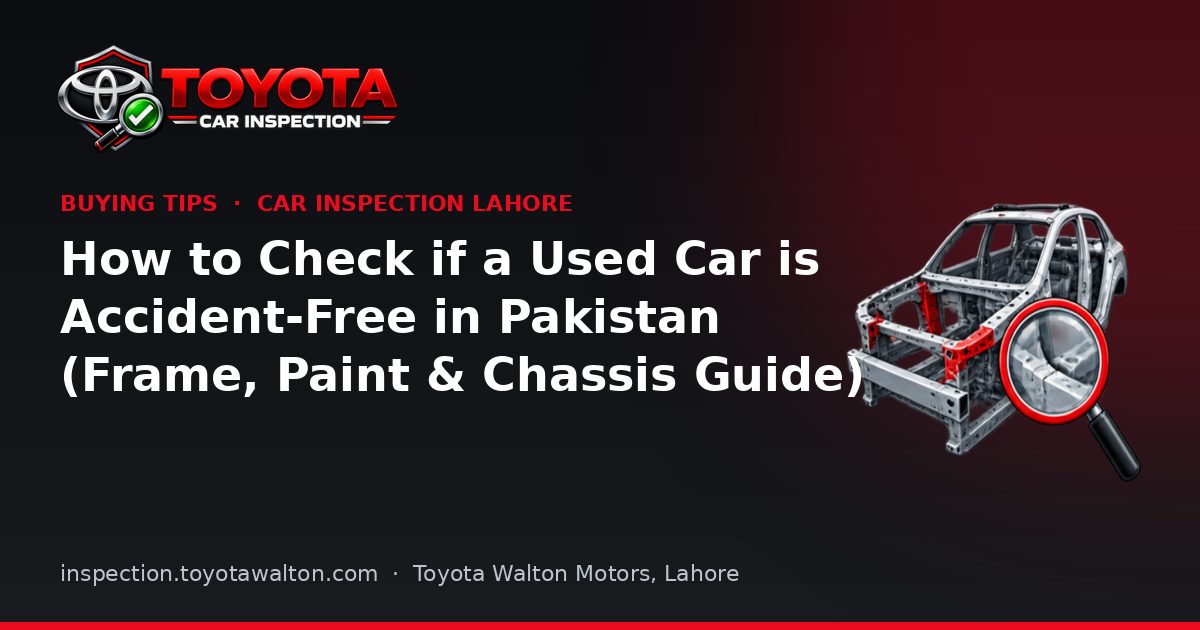
Sellers rarely admit an accident. Learn the ten signs inspectors look for — paint thickness, panel gaps, core support, pillar welds, airbag lights and more — and why a frame check matters most.
"Total genuine, no accident" is the most common line in every used-car ad in Pakistan — and one of the least reliable. A well-repaired accident car can look perfect in photos and even on a quick walk-around. Here is how professional inspectors actually find the truth.
1. Paint depth and colour match
Factory paint has an even thickness. A repainted panel is thicker and often a slightly different shade under sunlight. Look along the car from the front and rear at a low angle: repainted doors and fenders show a different reflection. In our reports these panels are marked RP (Repainted).
2. Panel gaps and alignment
Bonnet-to-fender, door-to-pillar and trunk gaps must be equal on both sides. Uneven gaps mean a panel was removed or the structure behind it moved.
3. Bolt heads and seals
Factory bolts on fenders, bonnet and doors have untouched paint. Wrench marks or bare metal mean the panel was taken off. Rubber seals on doors and windscreen should be clean — glue marks show a replaced windscreen (RL in our report).
4. Core support and radiator area
The upper core support (the beam above the radiator) is the first thing to bend in a frontal hit. Welds should look factory — smooth, with sealer. Fresh black paint or hand welds here are a red flag, and this is why our Frame / Accident section is scored separately.
5. Pillars, sills and floor
A-, B- and C-pillars and the rocker panels are structural. Any repair here lowers the frame score sharply. Open all doors and look at the pillar edges: factory spot welds are round and evenly spaced; hand welds are not.
6. Trunk floor and rear panel
Lift the trunk carpet. Wrinkled metal, fresh sealer or a repainted spare-wheel well means a rear-end collision.
7. Airbag and warning lights
Turn the key on: all warning lights should come on and then go off. A missing airbag light can mean the bulb was removed after an airbag deployed.
8. Headlights and bumpers
Mismatched headlight brands, new bumper clips or paint overspray on the grille are cheap tells of a front collision.
9. Chassis / VIN plate
The VIN plate must be original and match the registration book and the stamped number on the body. Our inspector photographs it for every report.
10. Drive it
A car that pulls to one side, steers off-centre or wears tyres unevenly often has a bent sub-frame even when the body looks fine.
When to get a professional frame inspection
If any two of the signs above appear — or the price seems too good — book a full inspection. The report marks every panel on an exploded-view damage map, so you can see at a glance which parts are original, repainted or replaced, and the QR-verified report gives you a strong negotiation tool.